
History of Sumo: From Shrine Ritual to National Sport
Published 10 Nov 2026
Short answer: The history of sumo runs from myth to professional sport. A wrestling match between two gods appears in a manuscript of 712, the first historically attested bouts were held at court in 642, and the sport was professionalised in the Edo period, when charity tournaments at shrines were permitted from 1684. Six tournaments a year have been held since 1958.
Sumo is often called Japan's oldest sport, and the claim holds up better than most. This guide follows the history of sumo from shrine ritual to the modern calendar, and shows which parts of it you still see at a bout today.
In this guide
- History of sumo: the timeline
- Myth and the first recorded bouts
- Court ritual in the Heian period
- Warriors, Nobunaga and the ring
- The Edo period and professional sumo
- The modern sport
- What survives at a show today
- Frequently asked questions
- Venue and booking details
History of Sumo: The Timeline
The dates below follow Wikipedia's article on sumo.
When | What happened |
|---|---|
23 BC | The Nihon Shoki dates the first match between mortals to this year. Treat it as mythology |
642 | The first historically attested bouts, held at the court of Empress Kogyoku for a Korean legation |
712 | The Kojiki describes a match between two gods for possession of the Japanese islands |
Heian period | Court events called sumai no sechie; the first set of rules appears |
Kamakura period | Sumo is repurposed as combat training for samurai |
February 1578 | Oda Nobunaga holds a tournament of 1,500 wrestlers, with circular arenas marked out |
1684 | Charity tournaments are permitted on shrine property; the first sanctioned tournament is held at Tomioka Hachiman Shrine |
1925 | The Japan Sumo Association reunites, on 28 December |
1949 | Tournaments are extended from ten days to fifteen |
1958 | The year moves from four tournaments to six |
1985 | The Kokugikan arena moves from Kuramae to Ryogoku |
Myth and the First Recorded Bouts
Two different kinds of origin story sit at the start of sumo, and it helps to keep them apart.
The mythological one comes first in the sources. A Kojiki manuscript of 712 describes the gods Takemikazuchi and Takeminakata wrestling for possession of the Japanese islands. The Nihon Shoki, published in 720, dates a first match between mortals to 23 BC.
The historical one is narrower and firmer. The first bouts that can actually be attested were held in 642, at the court of Empress Kogyoku, to entertain a visiting Korean legation. Sumo begins its documented life as a court performance.
Court Ritual in the Heian Period
During the Heian period, sumo became a regular court event known as sumai no sechie, and the first set of rules was written down. This is the period that fixed sumo as ceremony rather than brawling.
The religious connection dates from here too. Bouts were tied to shrine ritual and the agricultural year, which is why so much of what happens around a modern bout looks like a ceremony rather than a sport.
Warriors, Nobunaga and the Ring
In the Kamakura period, the emphasis shifted again. Sumo was repurposed as combat training for samurai, and the ceremonial element gave way to practical fighting.
The ring itself arrived later. In February 1578, Oda Nobunaga held a tournament of 1,500 wrestlers and had circular arenas marked out for it. That is the invention of the dohyo, the raised ring still used today.
The Edo Period and Professional Sumo
Sumo nearly lost its footing in the Edo period. It was temporarily banned in Edo because of street fighting, and the modern sport exists because of the compromise that followed.
From 1684, tournaments were permitted as charity events on Shinto shrine property, and the first sanctioned tournament took place at Tomioka Hachiman Shrine. Professional organisation followed, and sumo became a paid occupation rather than an occasional spectacle.
That shrine-ground compromise explains a lot. Sumo stayed close to its religious form at exactly the moment it became a business.
The Modern Sport
Three dates define the sport as it runs now. The Japan Sumo Association reunited on 28 December 1925. Tournaments grew from ten days to fifteen in 1949. And since 1958, six tournaments have been held each year.
The arena followed in 1985, when the Kokugikan moved from Kuramae to Ryogoku, where the Tokyo tournaments are still held. Our guide to Ryogoku covers the district, and the sumo tournament schedule has the current calendar.
Women are not permitted to compete in professional sumo or to enter the ring, a restriction tied to Shinto and Buddhist belief. Female sumo, onnazumo, existed in parts of Japan before the professional sport was established.
What Survives at a Show Today
The history is not decoration. Most of what a first-time viewer finds strange is a surviving ritual.
- The roof over the ring is a shrine form, kept above a sporting arena.
- The salt thrown before a bout purifies the ring, as at a shrine.
- The stamping drives out bad spirits, a gesture older than the professional sport.
- The ring itself descends from those circular arenas marked out in 1578.
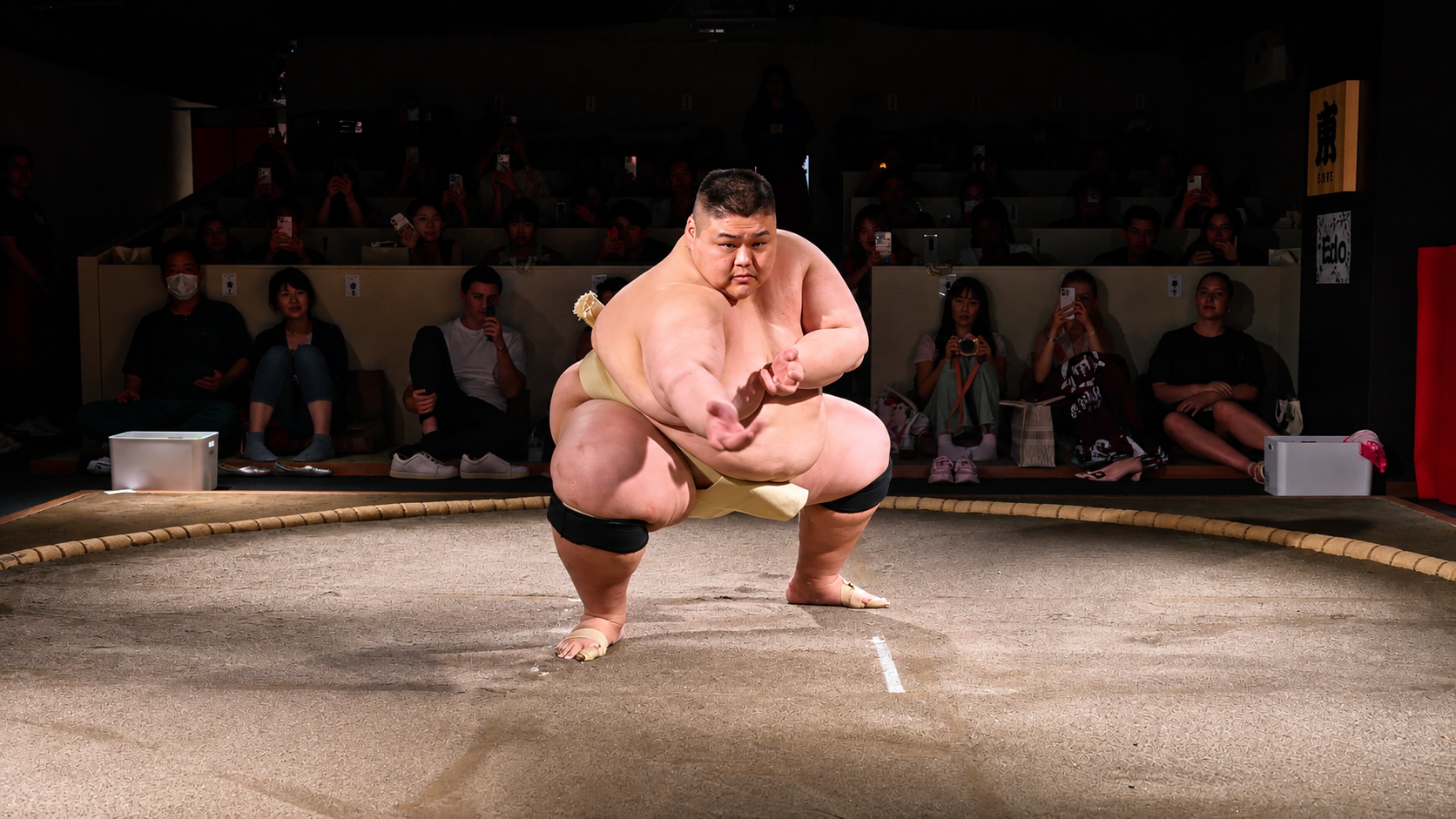
At Tokyo shows, retired professional wrestlers perform real bouts while an English-speaking host explains where each ritual comes from. A show runs about 90 minutes and costs ¥10,000 per adult, with one drink included (checked Nov 2026). Our guide to sumo rules for beginners covers what happens in the ring.
Conclusion
The history of sumo is a long argument between ritual and sport, and neither side ever won outright. That is why a modern bout still opens with salt and a roof shaped like a shrine. Watch one up close and the history stops being a timeline.
Frequently Asked Questions
How old is sumo?
The first historically attested sumo bouts were held in 642, at the court of Empress Kogyoku. Mythological accounts reach further back: a Kojiki manuscript of 712 describes a match between two gods, and the Nihon Shoki dates a first match between mortals to 23 BC, which historians treat as legend rather than record.
Why is sumo connected to Shinto?
Sumo developed as court and shrine ritual, tied to the agricultural year, and its religious form was preserved when it turned professional. From 1684, tournaments were allowed as charity events on shrine property. The roof above the ring, the salt thrown before a bout and the stamping all come from that shrine tradition.
When did sumo become a professional sport?
In the Edo period. Sumo was temporarily banned in Edo after street fighting, then permitted from 1684 as charity events on shrine grounds, starting with a sanctioned tournament at Tomioka Hachiman Shrine. A professional organisation of wrestlers developed from there, and the sport has been paid work ever since.
Who invented the sumo ring?
The ring is usually traced to a tournament held by Oda Nobunaga in February 1578, for which circular arenas were marked out for 1,500 wrestlers. That event is treated as the invention of the dohyo. The raised clay ring used in professional sumo today descends from it.
Why are there six sumo tournaments a year?
The modern calendar settled in 1958, when the number of annual tournaments rose from four to six. Tournament length had already been extended from ten days to fifteen in 1949. Together those two changes created the schedule the sport still runs on, with 90 competition days each year.
Can women compete in sumo?
Not in the professional sport. Women are not permitted to compete or to enter the ring, a restriction linked to Shinto and Buddhist belief. Female sumo, known as onnazumo, existed in parts of Japan before professional sumo was established, and amateur women's sumo is practised today.
Where was the first sumo tournament held?
The first sanctioned tournament of the professional era was held at Tomioka Hachiman Shrine in Edo, after charity tournaments on shrine property were permitted in 1684. The shrine is in the Koto ward of modern Tokyo. Court bouts had been held far earlier, from 642 onwards.
Can I see traditional sumo rituals in Tokyo today?
Yes. The rituals survive in the modern sport, and Tokyo shows explain them as they happen, with an English-speaking host and retired professional wrestlers. Shows run several times a day for ¥10,000 per adult, with one drink included, as checked in November 2026.
Venue and Booking Details
- Shinjuku Sumo Club: Sekisaku Building 2F, 2-5-22 Okubo, Shinjuku-ku, Tokyo · 9:30–22:30 (last entry 20:00) · near Shin-Okubo and Higashi-Shinjuku stations
- Shinjuku Kabukicho Sumo Club: K-SQUARE 1F, 1-8-4 Okubo, Shinjuku-ku, Tokyo · near Shin-Okubo Station
- Shibuya Sumo Club: Daiichi Silver Building, 5-20-11 Sendagaya, Shibuya-ku, Tokyo · 9:00–21:00 · 1-minute walk from JR Yoyogi Station
- Shows: about 90 minutes · hosted in English · one drink included · same-day seats often available
- Book: travelingjapan.com/brands/sumo-show